The Best Brisket Knife in Australia: What to Look For and Where to Find One
There's a moment at every great Australian BBQ — just after the brisket comes off the smoker, bark set, resting quietly under a tea towel — when everything comes down to the knife in your hand.
Twelve hours of slow cooking. A serious cut of beef. The whole table watching.
And you're about to drag a supermarket carving knife through it.
If that sentence made you wince, you already know you need a proper brisket knife. This guide will walk you through exactly what to look for, why most knives fall short, and which Australian-made options are worth your money.
Why Brisket Demands Its Own Knife
Brisket is a uniquely demanding cut. It's large, irregularly shaped, has a thick fat cap on one side and a pronounced grain you need to cut against. The bark — that lacquered crust that forms after hours of smoke — is both the prize and the challenge. Too much pressure with the wrong blade and you crush it. A sawing motion tears the fibres and loses juice you spent half a day building.
A true brisket knife isn't just a long knife. It has specific characteristics that make the difference between a clean, presentation-worthy slice and a shredded mess.
Length matters. You want at least 250–270mm of usable blade. A full packer brisket is wide, and you need to draw the knife through in a single smooth stroke rather than rocking and lifting repeatedly. Every additional contact point is another opportunity to lose juice and damage the bark.
The blade should be thin and flexible at the tip. You're not chopping here — you're drawing. A thick, rigid blade requires more downward force, which compresses the meat. A thinner blade with a slight flex navigates the cut with far less resistance.
A curved or cimeter profile is ideal. The gentle belly of a curved blade allows a natural drawing cut that follows through the meat rather than pushing it. Traditional butchers have used this shape for carving roasts for generations, and it remains the gold standard for brisket.
Granton edges help. Those oval hollows ground into the blade face reduce suction and surface tension, so slices release cleanly rather than sticking.
What Most Australians Are Using (And Why It's Letting Them Down)
Walk through most Australian backyards on a Sunday and you'll see the same story: a budget carving knife from the kitchen drawer, or one of those long-bladed "electric knife" sets that have been in the family since 1994. These tools aren't designed for brisket. They're too short, too rigid, too dull, and built to a price point rather than a performance standard.
The overseas BBQ market — particularly the US — has embraced dedicated brisket slicers for years. Australian BBQ culture has exploded in quality and seriousness over the past decade, with more backyards running offset smokers, kamado grills and kettle setups than ever before. The knives just haven't kept up.
That's starting to change.
The Koi Knives Australian BBQ Collection
Koi Knives is a South Australian brand built on second-generation blacksmithing heritage. Every piece in the BBQ range is handcrafted in Clarence Park, SA, using premium Japanese VG10 steel — a high-carbon stainless steel hardened to 60–61 HRC that holds an edge through dozens of cookouts without needing attention between uses.
The handles are made with Australian timbers, resin, and materials that tell a story about where these knives come from. The aesthetic is distinctly Australian — not a copy of a Japanese or German design philosophy, but something that belongs here.
The full range is available at the Koi Knives Australian BBQ Collection. Here are the three standout options for anyone serious about brisket.
Option 1: The BBQ Brisket Collection
For: The dedicated pitmaster who wants the purpose-built setup.
The BBQ Brisket Collection is built around one job: slicing brisket properly. The long slicer blade is designed to make clean, single-stroke cuts through a full packer — no sawing, no pressure, no mess.
This is the option if brisket is a regular event at your place and you want the right tool rather than a compromise. A purpose-built brisket slicer in Australian hands, made from steel that holds an edge, with a handle that feels like it was made to be there.
Option 2: The Mixed BBQ Knife with Echidna Fork
For: The backyard cook who wants a premium carving experience from prep to plate.
The Mixed BBQ Knife with Echidna Fork ($395 AUD) pairs Koi's signature BBQ steak knife with the Echidna Fork — a bold, distinctly Australian piece that gives you full control of whatever you're carving.
The fork holds the brisket steady as you slice. The knife does the work. For tomahawks, whole brisket flat, or anything you're carving tableside in front of a crowd, this is the set that makes it feel like a moment, not just a meal.
The mixed handle design — Australian wood and resin — means every piece is unique. No two are exactly alike.
Option 3: The Ultimate BBQ Set — All Purpose Knife, Brisket Slicer & Fork
For: The serious outdoor cook who wants to be equipped for everything.
The Ultimate BBQ Set ($695 AUD) is the complete three-piece solution. It includes:
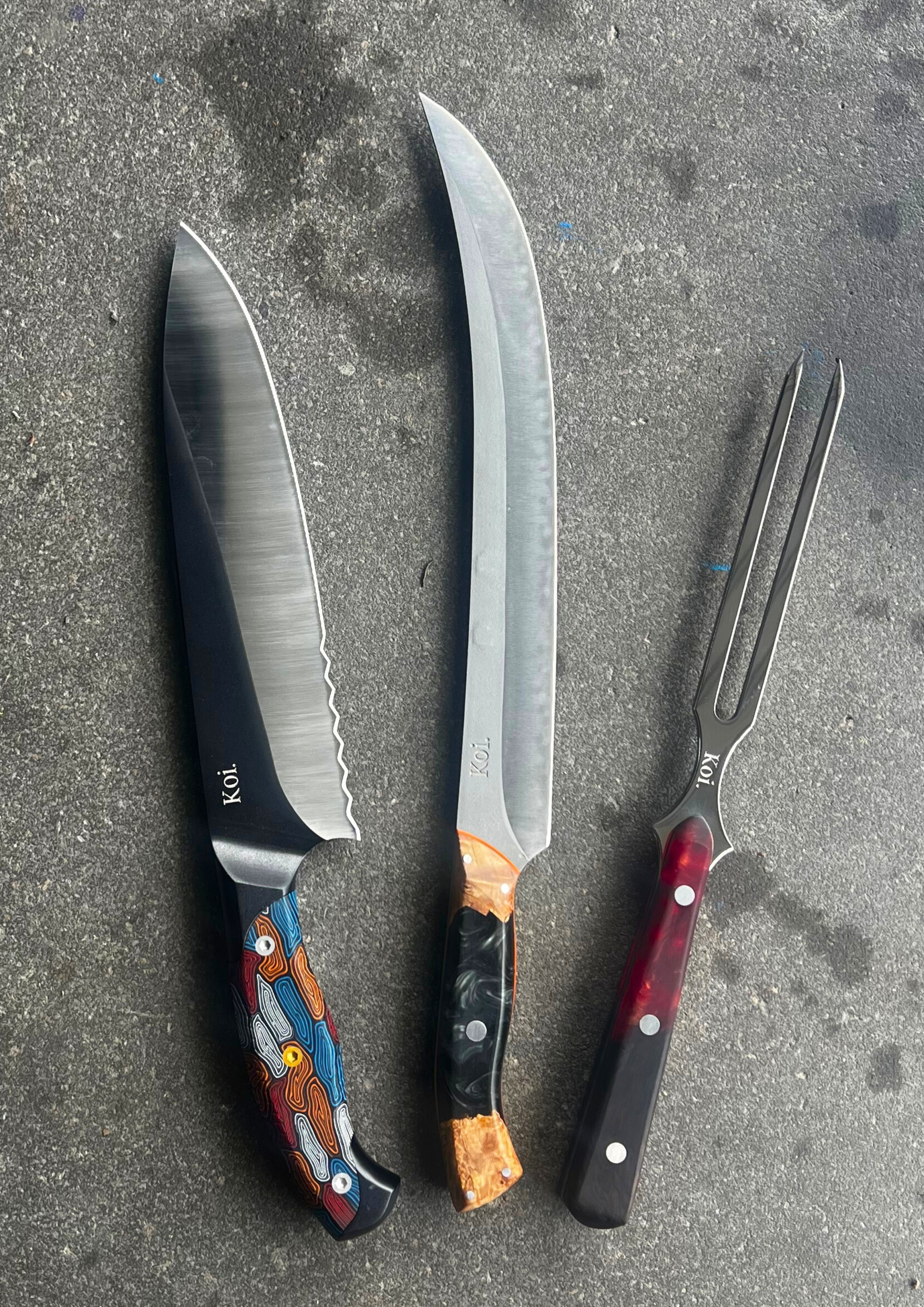
The King of the BBQ Knife — a versatile all-purpose blade that handles butchery preparation, rough breaking down of large cuts, and tableside carving. The mixed Australian wood and resin handle is as much an aesthetic statement as it is a functional grip.
The Brolga Cimeter/Slicer — this is the brisket knife itself. At 270mm, with a long curved blade inspired by traditional butcher's steak knives, the Brolga is built specifically for drawing cuts through large roasted meats. The cimeter profile allows the blade to glide through brisket, ribs, or whole chicken with minimal moisture loss. Your guests are watching. This is what they came for.
The Thorny Devil Carving Fork — inspired by the native Australian lizard, this two-pronged fork made with Sandvik steel and an ebony wood handle holds your protein steady while you slice. Safer, more precise, and considerably more satisfying to use than improvising with whatever's in the drawer.
All three blades are sharpened to 15° — a professional edge that you won't find on anything from a department store. They're handcrafted in South Australia by a second-generation blacksmith with VG10 steel at 60–61 HRC, meaning they hold that edge through real use, not just a test cut on opening day.
This is the set you hand down.
How to Use a Brisket Knife Properly
Even a great knife needs the right technique. Here's what separates a clean slice from a wasted effort:
Rest the meat properly first. A brisket pulled straight from heat hasn't finished redistributing its juices. Give it 30–60 minutes loosely wrapped. A rested brisket slices cleanly. An unrested one bleeds out on the board.
Identify the grain before you cut. Brisket has two muscles — the flat and the point — with grains running in different directions. Slice against the grain in both sections, even if that means turning the brisket partway through. Slicing with the grain gives you tough, stringy results no matter how good your knife is.
Use a drawing motion, not a pushing one. Pull the knife toward you in one smooth stroke, using the full length of the blade. You should barely need to apply downward pressure. If you're pressing, your knife isn't sharp enough or the technique is wrong.
Slice to 6–8mm thickness. This is the sweet spot for brisket. Thinner and it falls apart; thicker and the texture becomes heavy. If you have a good brisket knife, this is easy to maintain consistently.
Wipe the blade between slices. Brisket fat is flavourful but sticky. A quick wipe keeps each slice clean.
Caring for Your Brisket Knife
A VG10 knife will reward care with a decade or more of sharp, reliable performance. A few rules:
Never put it in the dishwasher. The heat, detergent, and movement will damage the blade edge and handle over time. Hand wash with warm soapy water and dry immediately.
Hone it with a ceramic rod between uses. Ceramic is harder than VG10 and realigns the edge without removing steel. Don't use a steel honing rod — it's too soft for the job and can alter the edge geometry.
Sharpen on a whetstone when needed. Pull-through sharpeners remove too much metal too aggressively. A whetstone at 15° gives you full control and a superior edge.
Oil the handle periodically with camellia oil or a similar natural oil to keep Australian timber handles looking their best.
The Bottom Line
The best brisket knife in Australia doesn't come from a supermarket or a generic online marketplace. It comes from someone who understands what the tool is for and builds it to that standard.
Koi Knives makes BBQ tools the same way they make everything else — with proper steel, proper craft, and a clear sense of what Australian cooking deserves.
If you're serious about brisket, browse the full Australian BBQ Collection here and find the setup that fits how you cook.
Koi Knives is handcrafted in Clarence Park, South Australia. All knives are made by a second-generation blacksmith using Japanese VG10 steel and Australian materials. Free express shipping upgrades available for Australian orders — email ramon@koiknives.com.