

"Michael" | The Mallard Duck Pocket Knife
Ask anyone in Australia to draw a duck and they'll draw this one. It isn't from here.
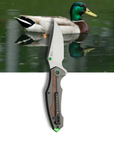
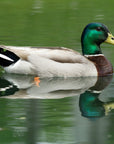
Bottle-green head, white collar, chestnut breast over a clean grey body. The Mallard is, objectively, one of the best-dressed birds on the planet. It is also the most abundant duck on it. Neither of those things happened by being polite.
It was brought to Australia from the Northern Hemisphere in the late 1800s and has been settling in ever since — parks, ponds, city lakes, anywhere with bread and an audience. Charming. Adaptable. A little bit of a problem.
The problem is that it doesn't just visit. It interbreeds with our native Pacific Black Duck — readily, fertilely — and when it does, the Mallard's genes win. Generation after generation the native markings fade toward the newcomer's. On Lord Howe, on Macquarie, across the Tasman in New Zealand, pure black ducks have been all but bred out. In Tasmania it's getting hard to find one without a bit of blow-in in the bloodline.
So no, the Mallard doesn't belong here. We know. We named a knife after it anyway, because pretending it isn't here doesn't make it leave, and because a brand that only tells the flattering half of the story isn't telling the story.
Consider Michael our honest houseguest. Beautiful, uninvited, and staying.
The dress code
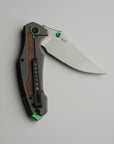
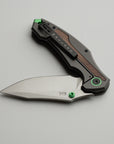
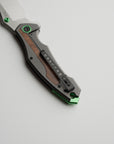
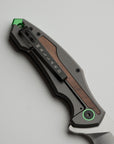
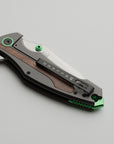
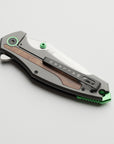
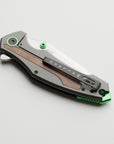
Michael wears his namesake. A grey titanium frame for the drake's clean body. Iridescent green anodising through the pivot, flipper, standoffs and clip, for the head that gives the bird away in any light. And a chestnut timber inlay, a nod to the breast, and to the native it can't quite stop imitating.
He is the flashier of the two ducks. He would be. That's rather the point.
The machine underneath
Michael and Wendy the Wood Duck are the same knife under the plumage. We designed the platform once, properly, and let the two birds tell their own stories.
95 mm of Sandvik 14C28N, ground to a drop point with a long, clean belly for slicing and a fine tip for detail — the geometry of a knife that earns its keep, whether it's grazing through a day of small jobs or standing guard over a bigger one. Titanium frame, timber inlay, frame lock. Flipper tab and thumb stud, so you can open it fast or open it deliberately. Deep-carry clip, glass breaker, jimping where your thumb lands. 125 grams, and 10 mm across the handle — enough to feel like something, thin enough to forget.
Specifications
| Overall length (open) | 200.6 mm |
| Closed length | 116.3 mm |
| Blade length | 95 mm (84 mm exposed) |
| Blade thickness | 3.5 mm |
| Handle thickness | 10 mm |
| Weight | 125 g |
| Steel | Sandvik 14C28N |
| Blade type | Drop point |
| Deployment | Flipper tab and thumb stud |
| Lock | Frame lock |
| Frame | Grey titanium, chestnut timber inlay |
| Hardware | Titanium and stainless steel, green anodised |
| Clip | Deep carry |
| Features | Thin profile, glass breaker, grip jimping |
A note on the clips
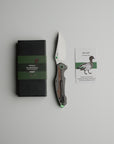
Some of these photographs were taken with test samples, built with identical clips across both knives. After showing them to a few local collectors we changed the Mallard clip so it carries its own personality. Every Michael we ship has the updated clip shown in the final images.
Two ducks
One belongs here. One talked its way in. We made both, because that's honest, and because the argument between them is the most Australian thing about a duck. Meet Wendy the Wood Duck.
And a word on the real bird in all this: the Pacific Black Duck, the native the Mallard is quietly breeding out, is worth knowing, worth watching, and worth keeping around. If the Mallard's story bothers you, good. It should.
We produce durable, high-quality knives and products for both culinary and utility use.
We stand behind the craftsmanship of our knives with this limited warranty.
All Koi Knives products are warranted to be free from defects in materials and workmanship during the period of one year from the original date of purchase by the end user.
Should a manufacturing defect arise within the warranty period, We will repair
or replace the knife at our discretion without charge.
Please note: This warranty does not cover damage resulting from improper use or care, accidents, modification, commercial use, neglect, or regular wear and tear over time. We are not responsible for knives that have been damaged from misuse such as dropping, improper cleaning methods (like putting the knife through a dishwasher), or excessive force.
If you have any warranty questions or queries please feel free to contact us.
Please note: We recommend washing blades by hand using warm soapy water and drying them straight away or in any way that does not have water pooling on the blade.
Handles can be oiled using a natural oil such as a Camellia oil.
WARNING: You must be at least 18 years of age to purchase any knives from our store or website - whether it be kitchen, outdoor, or pocket knives.
We ship orders on Tuesdays and Thursdays via Australia Post.
Example: If you place your order on Thursday at 9:30pm, we will ship it the following Tuesday.
Orders within Australia should arrive within a week.
International orders can take between 1-4 weeks to arrive.
Tracking information will be sent to you via Australia Post when your order has been dispatched.
*Only if an email address has bee provided.
Express shipping: If you are wanting your order in a hurry please add a note in with your order and we can upgrade you to express shipping for free.
Or you can email ramon@koiknives.com
*Only for Australian orders
International Orders: Please note there may be additional taxes and duty applied by customs in your country.
Unfortunately we can't tell you how much this would be as each country is different.
A handy guide to use is https://www.simplyduty.com/import-calculator/
YOU MUST BE 18+ YEARS TO PURCHASE A KNIFE
The knives sold by Koi are intended for culinary and food preparation use only.
While robustly constructed, knives can potentially cause harm if misused or used for unintended purposes.
Koi does not assume any liability for damages or injuries that result from improper, dangerous or illegal use.
It is the responsibility of the purchaser to use Koi knives carefully and as directed, store them safely and keep them away from unsupervised children.
By purchasing from Koi, you agree that any misuse of the products is solely your responsibility.
Koi shall not be held responsible or assume any liability in the event of accidents due to disregarding safety instructions or using the product in a way other than its intended use.
We appreciate your support of our small business and hope you enjoy cooking safely with your new Koi knives for many years to come.
Please contact us if you have any other questions.
"Stay sharp and have a knife day"
This knife is built to last with minimal maintenance.
But you still need to look after the knife.
1. Keep the blade nice and dry
It’s important to properly care for and maintain the knife blades. Extended exposure to moisture can potentially cause corrosion in even the most resilient steels over time. It’s essential to dry blades thoroughly after cleaning and avoid prolonged contact with water whenever possible.
The high-carbon steel core of the our knives also requires special care. Carbon steel is more prone to rust if moisture is not fully removed. Be sure to wipe away any moisture on the blade.
When hand washing is necessary, use warm water and avoid soaking the knives for extended periods. While hot water alone won’t typically damage the blade, sudden temperature changes can cause cracking at the microscopic level. Extreme hot or cold should be avoided.
By keeping blades clean and dry, and limiting exposure to moisture, your knife can maintain their corrosion resistance and withstand daily use for many years of dependable performance.
2. Do not put the knife through the dishwasher.
Please.
Do not put your knife in the dishwasher.
Here are a few key reasons why we don't recommend putting your new knife in the dishwasher:
Heat - The high heat of a dishwasher drying cycle can cause microscopic damage and weakening of the blade over time. High carbon steels like VG10 are more vulnerable to heat-related damage.
Moisture - Prolonged exposure to moisture in the dishwasher isn't fully controlled and can lead to rust or corrosion developing on the blade more easily than hand-washing. Wood and water also do not like each other over time.
Detergents - The harsh detergents and cleaning chemicals used in dishwashers aren't designed with knife blades in mind and could potentially cause unwanted reactions or deterioration of protective blade coatings.
Movement - The agitation and bouncing around of knives in a dishwasher creates risk of nicks or dulling of the cutting edge from contact with other dishes.
Aesthetics - Over time, dishwashers may cause discoloration or other undesirable visual changes to the blade appearance or handle.
Hand-washing allows for more gentle, careful cleaning without extended heat or chemical exposure - helping to maintain the VG10 steels' sharpness and corrosion resistance for longer. Taking the extra minute for hand washing is best for your quality knife.
3. Don't use pull through or machine sharpeners.
There are a few key reasons why pull-through/electric knife sharpeners are not recommended for high-carbon steel chef's knives:
They can remove too much metal. High-carbon steels are harder and more brittle than softer stainless steels. Aggressive sharpeners can easily remove too much steel, thinning and damaging the blade edge over time.
They can create a rounded/rolled edge. Pull-through sharpeners can push the edge inward, rounding it rather than honing a sharp, angular apex. This diminishes cutting performance.
Improper angle. It's hard to set the proper angle consistently for each knife with an electric sharpener. An improperly aligned edge won't hold its sharpness as well. We sharpen the nearly all our knives at 15°
Risk of overheating. The friction from an electric sharpener, especially on hard carbon steels, carries a risk of overheating and potentially ruining the blade's temper or microstructure.
Better options exist. Whetstone sharpening allows for precise angles, control over steel removal, and developing a fine, polished edge that stays sharper longer than a pull-through can provide.
For high-performance knife blades like high-carbon, it's best to use more precise and gentle sharpening methods that don't deform or damage the metallurgy of the knife edge.
Whetstones are our preferred method of sharpening.
4. Hone it using a ceramic rod
There are a few key reasons we recommend only using a ceramic honing rod on Koi Knives:
Hardness. VG10 steel is extremely hard, around 61-62 on the Rockwell scale. A softer steel or diamond honing rod could potentially scratch or damage the blade edge during use. Ceramic is harder than the knife steel.
Edge alignment. Ceramic honing rods gently realign the edge of the knife without removing any material. This helps maintain the factory angle and honed cutting geometry over time. Other methods may change the angle.
No burrs. As a harder material, ceramic won't roll or form burrs on the knife edge like other honing steels can. Burrs lead to diminished cutting performance.
Smooth surface. Ceramic rods offer an exceptionally smooth sliding surface, which reduces friction and potential for burning/overheating the edge during honing strokes.
Longevity. Hardest of all honing materials, ceramic will also last essentially the lifetime of the knife without wearing down from use like softer steels can.
For high-performance supersteels like VG10 that we're using in our knives, only ceramic honing maintains the pristine edge geometry without risk of micro-damage, burrs or changing the factory-set angle over numerous sharpening cycles.
5. Care for the handle
It's important to keep in mind that wood, like many natural materials, is vulnerable to the effects of excess water exposure. When wooden handles get wet, they tend to expand slightly and then contract again as they dry. Repeated cycles of expansion and contraction can cause microscopic cracks to form in the grain of the wood.
For this reason, we recommend carefully hand washing your handles to minimise water contact as much as possible. A damp cloth is preferable to soaking or submerging. Thoroughly drying the handles afterwards also makes sure no residual moisture gets trapped.
With proper care, the wooden handle of your knife will maintain its attractiveness for years of use.
But exposing them to continuous wet environments or submerging them could expedite crack development.
By avoiding prolonged water submersion, the wood handles can be preserved looking as fine as the day they were crafted.
6. Do not put your knife through the dishwasher.
Just in case you missed it the first time.
Do not put your knife in the dishwasher.
Follow these steps and your new knife will treat you well for years to come.